Generative AI Security Risks Every Product Team Should Understand
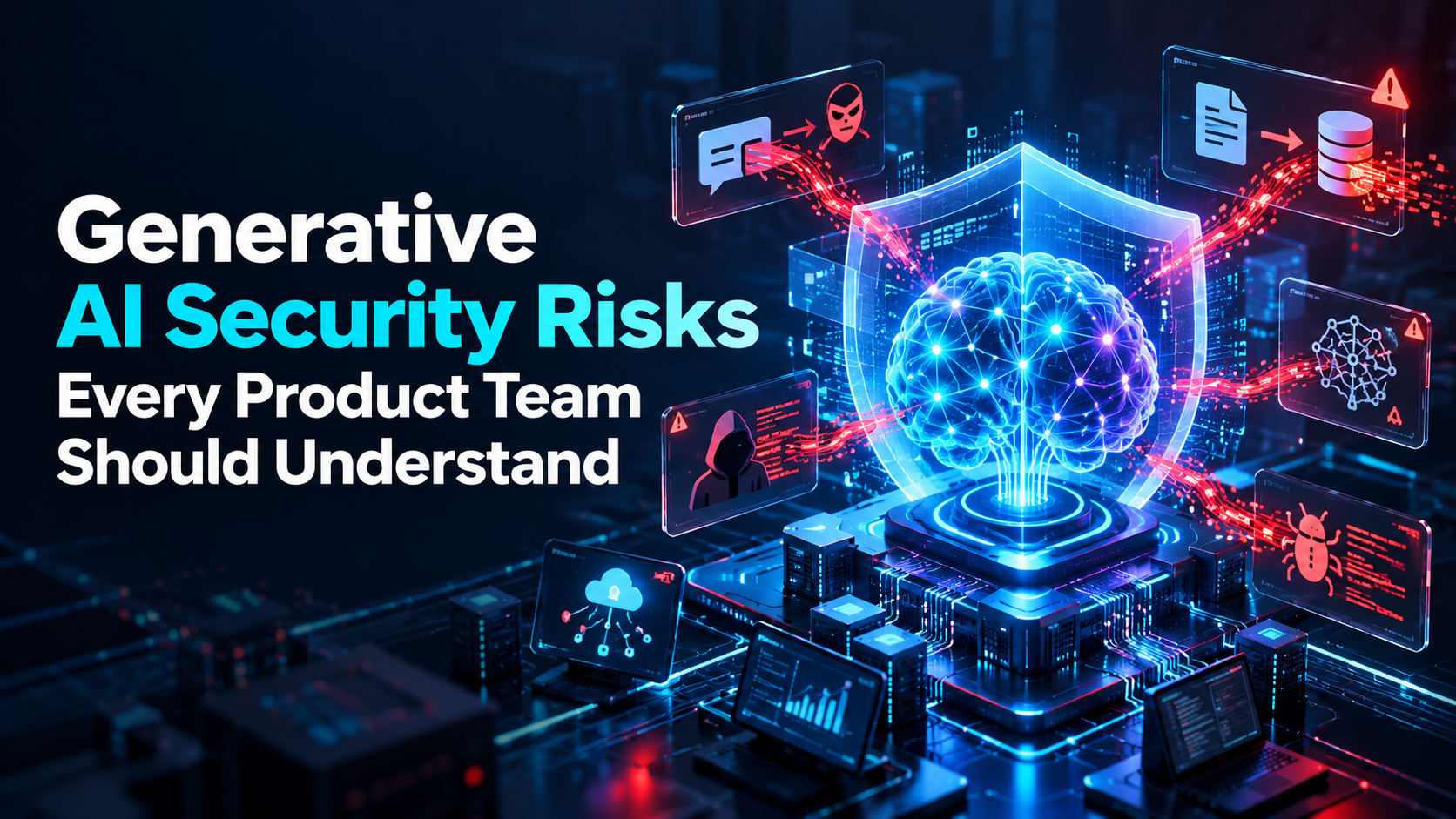
Generative AI can improve product experiences through intelligent chatbots, automated workflows, personalised recommendations, and AI-powered assistants. However, integrating these capabilities also introduces security risks that traditional application security practices may not fully address. From sensitive data exposure to prompt injection, a single vulnerability can compromise user trust, business information, and product reliability.
For product managers, CTOs, and engineering teams, understanding these risks is essential before deploying AI features. A proactive security strategy helps organisations build reliable AI-powered products while reducing operational, financial, and reputational risks.
1. Data Leakage and Privacy Violations
Generative AI systems often process customer information, internal documents, business records, and proprietary data. If this information enters prompts, model logs, or external AI services without appropriate safeguards, sensitive details could be exposed to unauthorised parties.
Product teams should classify data before processing it, remove unnecessary personal information, encrypt sensitive data, and enforce role-based access controls. They should also review AI providers' data retention policies and ensure confidential information is not used for model training without appropriate authorisation.
2. Prompt Injection Attacks
Prompt injection occurs when malicious instructions manipulate an AI model into ignoring intended restrictions or performing unintended actions. These instructions can appear directly in user prompts or indirectly in documents, websites, and other content the AI processes.
For example, an AI assistant connected to a company's knowledge base could be manipulated into retrieving restricted information if its access controls are poorly designed.
Teams should treat model inputs as untrusted, separate instructions from retrieved content where possible, validate outputs, and restrict the tools and data an AI system can access. Security testing should include adversarial prompts that attempt to bypass safeguards.
3. Inaccurate or Harmful AI Outputs
Generative AI can produce convincing but incorrect information, disclose inappropriate content, or generate responses that violate business policies. These failures become more serious when AI influences financial decisions, healthcare workflows, customer support, or other sensitive operations.
Implement output validation, content filtering, confidence-aware user experiences, and human approval for high-impact decisions. Regularly evaluate responses against realistic scenarios, including ambiguous questions and malicious inputs.
4. Insecure APIs and Excessive Permissions
AI features frequently connect language models with databases, payment systems, internal applications, and third-party APIs. Poorly secured integrations can allow attackers to access sensitive resources or trigger unauthorised actions.
Apply least-privilege access, secure API authentication, rate limiting, input validation, and proper secrets management. AI agents should receive only the permissions required for their specific tasks. Any action involving sensitive records, financial transactions, or account changes should include appropriate authorisation checks.
5. Third-Party Model and Supply Chain Risks
Many AI products rely on external models, plugins, open-source libraries, and cloud services. Vulnerabilities in these dependencies, unexpected provider changes, or inadequate vendor security practices can expose products to additional threats. Product teams should evaluate providers before integration, keep dependencies updated, review model permissions, and establish clear policies for data sharing, service availability, and incident reporting.
These risks can also arise from avoidable implementation mistakes. Understanding common AI integration mistakes can help product teams identify potential security gaps and make better decisions when connecting AI models with existing applications and business systems.
6. Insufficient Monitoring and Security Testing
AI security risks can evolve after deployment as user behaviour changes, models are updated, and new attack techniques emerge. Without continuous monitoring, teams may overlook suspicious usage, unusual data access, or declining output quality.
Implement automated security testing, audit logs, anomaly detection, and incident response procedures. Monitor AI inputs and outputs while protecting sensitive information in logs. Conduct regular red-team exercises and reassess security controls whenever models, integrations, or product capabilities change.
How Can Product Teams Reduce Generative AI Security Risks?
A practical approach combines secure architecture, data governance, continuous testing, and human oversight. Teams should assess threats during product discovery rather than waiting until launch. Security requirements must also evolve alongside the AI system, supported by clear ownership and documented incident response processes.
Conclusion
Generative AI security requires continuous attention to data privacy, prompt injection, model reliability, API permissions, and third-party dependencies. Product teams that address these risks early can build AI features that are more trustworthy, resilient, and scalable.
Businesses planning secure AI integrations can explore generative AI development services from RipenApps to build AI-powered solutions with security controls, responsible AI practices, and scalable architecture aligned with their product requirements.
FAQs
1. What are the biggest security risks of generative AI?
The major risks include data leakage, prompt injection, insecure integrations, harmful outputs, excessive permissions, and vulnerabilities in third-party AI services.
2. How can prompt injection be prevented?
Teams can reduce prompt injection risks through input handling, access restrictions, output validation, adversarial testing, and limiting the actions AI systems can perform.
3. Can generative AI expose confidential business data?
Yes. Poorly configured integrations, excessive access permissions, insecure logs, and unsuitable data-sharing practices can expose confidential information.
4. How often should AI security testing be performed?
Security testing should occur before launch, after significant model or architecture changes, and regularly throughout the product lifecycle.
5. Who is responsible for generative AI security?
Responsibility is shared across product, engineering, security, and compliance teams. Clear ownership ensures risks are assessed, controls are maintained, and incidents are handled effectively.
\
About the author
- Hi, I'm Asher, a passionate Content Writer specializing in SEO, AI, SaaS, and technology content. I create research-driven, user-focused content that simplifies complex concepts into engaging, actionable, and search-optimized articles. My expertise includes writing blogs, technical tutorials, website copy, product pages, and thought leadership content that helps brands improve visibility, establish authority, and drive organic growth. I combine strategic keyword research, audience insights, and clear storytelling to create content that not only ranks on search engines but also delivers real value to readers. Whether I'm writing about artificial intelligence, software development, digital marketing, or emerging technologies, my goal is simple: create content that educates, inspires, and delivers measurable results.
Comments
Join the discussionNo comments yet. Be the first to comment.